Evaluating the Autumn Chestnut Watercolor Plant Set for Seasonal Design Projects
Selecting digital assets for autumn-themed projects requires balancing aesthetic authenticity with technical versatility. The Autumn Chestnut Watercolor Plant Set occupies a specific niche within botanical illustration libraries, offering hand-painted elements that bridge the gap between traditional artistry and modern digital application. This collection, comprising seven distinct files featuring sweet chestnut leaves and plants, is designed for creators who require high-resolution transparency and organic color variation. Understanding the specific attributes of this set helps determine whether it aligns with your project requirements compared to vector alternatives, AI-generated imagery, or broader seasonal bundles.
Distinguishing Characteristics of Hand-Painted Botanical Assets
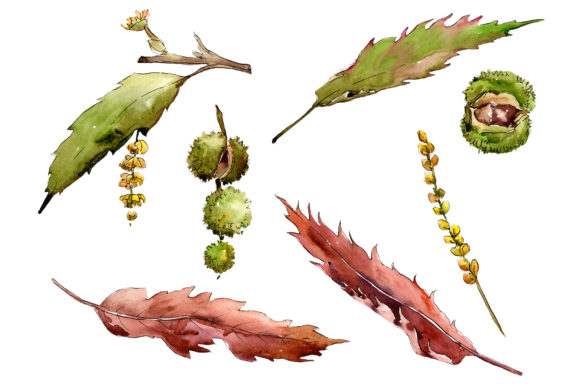
The primary value proposition of the Autumn Chestnut Watercolor Plant Set lies in its creation method. Unlike vector graphics constructed from mathematical paths, these illustrations are painted by hand and digitized as isolated PNGs. This distinction matters significantly for designers seeking texture and imperfection. Watercolor inherently possesses bleeding edges, pigment pooling, and brush stroke variations that software struggles to replicate authentically. When evaluating this set against standard clip art, the difference is visible in the transition zones between green and red foliage. The color gradients are not linear fills but layered washes, providing a depth that maintains visual interest even when scaled.
Furthermore, the subject matter is botanically specific rather than generic. Many autumn asset packs rely on stylized maple or oak silhouettes. By focusing specifically on sweet chestnut foliage, this set offers an alternative for designers looking to avoid cliché fall motifs. The inclusion of both green and red leaves allows for compositional storytelling, representing the transitional nature of the season rather than a static snapshot. For projects requiring biological accuracy or a more sophisticated, less cartoonish representation of autumn flora, this specificity is a critical decision factor.
Technical Specifications and Workflow Integration
For professional use, file specifications dictate utility. The Autumn Chestnut Watercolor Plant Set provides images at 3500x3500 pixels with a resolution of 300 DPI. This specification warrants comparison against industry standards:
- Resolution Sufficiency: At 300 DPI, a 3500px dimension supports print sizes up to approximately 11.6 inches square without interpolation. This makes the set viable for wedding invitations, greeting cards, and standard poster formats. However, for large-format signage or billboards, users may need to supplement these assets with higher-resolution sources or vector equivalents.
- Transparency and Isolation: Each element is delivered as an isolated PNG with a transparent background. This eliminates the need for manual masking or background removal, a significant time-saver compared to scanning physical paintings or purchasing non-isolated JPEGs. The clean alpha channels allow for seamless layering over textured papers, colored backgrounds, or photographic elements.
- Editability: While raster files cannot be reshaped like vectors, they remain fully editable regarding color grading, opacity, and blending modes. Designers can adjust hue/saturation layers to shift the red leaves toward burgundy or the green leaves toward olive, adapting the palette to specific brand guidelines without losing the underlying watercolor texture.
Comparing Raster Watercolors to Vector and AI Alternatives
When sourcing autumn foliage, designers typically choose between three categories: hand-painted rasters (like this set), vector illustrations, and AI-generated imagery. Each has distinct tradeoffs.
Raster vs. Vector Illustrations
Vector graphics offer infinite scalability and easy color editing, making them superior for logos or responsive web design. However, vectors often lack the organic complexity of real media. If your project demands a tactile, artisanal quality—such as a boutique wedding suite or a heritage brand label—the Autumn Chestnut Watercolor Plant Set provides a warmth that flat vectors cannot achieve. Conversely, if you require precise geometric alignment or frequent resizing beyond 12 inches, vectors remain the better choice. This watercolor set is best positioned as a textural overlay or focal point rather than a structural design element.
Hand-Painted vs. AI-Generated Botanicals
Generative AI tools can produce autumn leaves rapidly, but they frequently struggle with botanical consistency and logical vein structures. AI outputs also often come with baked-in backgrounds or artifacts requiring cleanup. The advantage of this curated set is reliability; every file is a verified, separate element with consistent lighting and style. For commercial projects where copyright clarity and anatomical correctness matter, licensed hand-painted assets reduce legal and quality assurance risks associated with synthetic generation.
Ideal Use Cases and Application Scenarios
The versatility of the Autumn Chestnut Watercolor Plant Set extends across multiple domains, though it performs better in some contexts than others based on its inherent properties.
Stationery and Wedding Collateral
This is perhaps the strongest fit. The combination of green and red tones complements cream, ivory, and kraft paper stocks commonly used in autumn weddings. The isolated format allows designers to create custom frames, corner accents, or divider lines without overwhelming text areas. Because the elements are hand-painted, they pair exceptionally well with serif typography and letterpress aesthetics.
Digital Content and Blogging
For bloggers and social media managers, the 3500px size provides ample headroom for cropping into various aspect ratios (Instagram stories, Pinterest pins, blog headers). The transparent backgrounds facilitate quick composition over branded templates. Unlike stock photos which can feel impersonal, these botanical elements add a customized, illustrative layer to quotes and article thumbnails.
Surface Pattern and Textile Design
While individual elements are useful, they also serve as building blocks for pattern creation. Designers can duplicate, rotate, and mirror the chestnut leaves to create seamless repeats for fabric printing or wrapping paper. The watercolor texture translates well to textile applications where slight irregularities are desirable. However, users should verify that the 3500px resolution meets the repeat size requirements of their specific print-on-demand service.
Limitations and Decision Factors
To make an informed purchase, one must acknowledge where this set may fall short. Transparency in evaluation prevents post-purchase frustration.
- Limited Variety: With only seven files, this is a focused accent pack rather than a comprehensive library. Designers needing dozens of unique species or extensive seasonal variety will need to bundle this with other resources.
- Raster Constraints: As mentioned, you cannot redraw paths or separate individual leaves from a branch if they were painted together. Ensure the existing compositions match your layout needs before acquiring.
- Color Dependency: While editable, shifting watercolor hues drastically (e.g., turning red leaves blue) can result in muddy artifacts. This set is optimized for naturalistic autumn palettes; forcing it into neon or pastel schemes may degrade quality.
- Style Consistency: Mixing hand-painted watercolors with flat graphic elements or 3D renders can create visual dissonance. This set works best when paired with other organic textures, paper grains, or traditional typefaces.
Making the Final Selection
The Autumn Chestnut Watercolor Plant Set represents a specialized tool for designers prioritizing organic texture and botanical specificity over infinite scalability. It excels in print collateral, digital branding, and decorative framing where the human touch of watercolor enhances the emotional resonance of the piece. When comparing options, weigh the importance of authentic media characteristics against the convenience of vector manipulation. If your project benefits from the nuanced interplay of pigment and paper texture, and if the sweet chestnut motif aligns with your thematic goals, this set offers a high-quality, technically sound foundation. For those requiring broader variety or structural flexibility, consider using this pack as a complementary texture layer alongside more robust vector libraries.