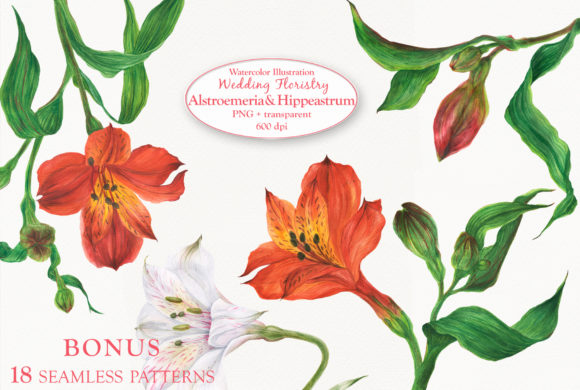
Alstroemeria Hippeastrum: A Practical Floral Asset Bundle for Wedding and Event Design
In the competitive landscape of event stationery and surface pattern design, sourcing high-quality botanical assets that balance aesthetic appeal with technical versatility is a constant challenge. The Alstroemeria Hippeastrum collection addresses this specific need by combining two distinct yet complementary floral species into a cohesive digital resource. Unlike generic stock libraries where elements often lack stylistic consistency, this bundle offers a curated set of hand-drawn watercolor illustrations specifically structured for professional application. For designers, florists, and print-on-demand entrepreneurs, understanding the functional value of these assets goes beyond their visual beauty; it requires an evaluation of resolution, file organization, and cross-media adaptability.
Botanical Synergy and Visual Characteristics
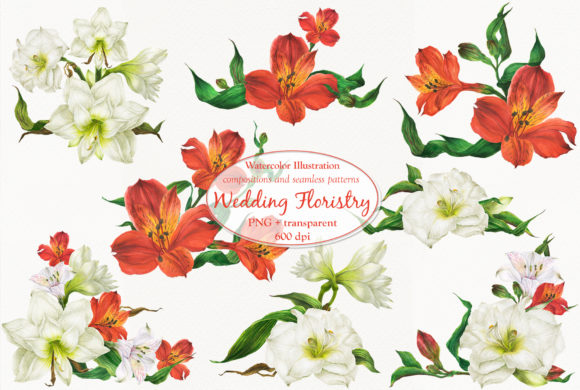
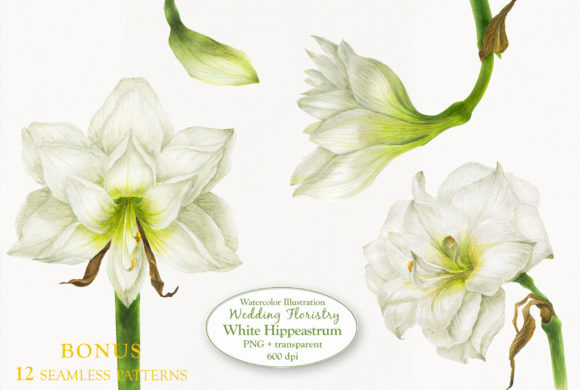
The pairing of Alstroemeria and Hippeastrum (commonly known as Amaryllis) is strategically sound for wedding and celebration markets. Alstroemeria, or the Peruvian Lily, brings delicate clusters, intricate petal markings, and abundant foliage that serve as excellent filler and texture in compositions. Conversely, Hippeastrum provides bold, structural focal points with large, dramatic blooms that anchor designs. This duality allows creators to build complete floral arrangements digitally without needing to source disparate assets from different artists, which often results in mismatched lighting, brushwork styles, or color palettes.
The watercolor medium used in this collection adds a layer of organic authenticity that vector art sometimes lacks. Watercolors naturally possess soft edges and color bleeds that mimic real ink on paper, making them particularly effective for invitation suites where a tactile, handmade feel is desired. The hand-drawn nature of these 55 objects ensures that no two petals are identical, preserving the natural imperfections that give botanical illustrations their charm. For professionals evaluating this resource, the key strength lies in this artistic consistency; every element feels like it belongs to the same painted session, streamlining the compositing process.
Technical Specifications and Production Quality
For any digital asset to be viable in professional production, technical specifications must meet rigorous print standards. The Alstroemeria Hippeastrum bundle is engineered with high-resolution output in mind, addressing common pain points regarding pixelation and scaling.
- Resolution and DPI: All 55 PNG elements are rendered at 600 DPI. This exceeds the standard 300 DPI requirement for commercial printing, providing significant headroom for resizing. A file dimension ranging up to 7500x8000 pixels allows designers to crop into specific flower details or scale down for small accents without losing edge definition.
- Transparency and Isolation: The inclusion of transparent backgrounds on all individual elements is non-negotiable for efficient workflow. It eliminates the tedious masking process required when working with flattened JPEGs, allowing for immediate drag-and-drop functionality in Adobe Photoshop, Illustrator, Affinity, or Canva.
- Pattern Tiling: The 18 seamless patterns are provided as 3000x3000 px JPGs at 600 DPI. Crucially, they maintain 300 DPI even when scaled to 10x10 inches. This specification confirms their suitability for textile printing and wallpaper, where repeat alignment and clarity at larger physical sizes are critical failure points for lower-quality assets.
From a quality assurance perspective, the 600 DPI baseline suggests these files were likely scanned or created at a higher native resolution and archived properly. This future-proofs the purchase against evolving print technologies and large-format display requirements.
Practical Applications Across Media
Versatility determines the return on investment for creative assets. While marketed heavily toward wedding floristry, the Alstroemeria Hippeastrum bundle demonstrates utility across multiple verticals due to its neutral yet vibrant colorway and classic botanical forms.
Stationery and Paper Goods
Wedding invitation suites demand hierarchy. The large Hippeastrum blooms function effectively as corner anchors or envelope flap accents, while smaller Alstroemeria buds and leaves work well for RSVP cards, table numbers, and menu borders. The transparent PNGs allow for easy layering over colored cardstock textures or vellum overlays without creating white halos. For postcards and thank-you notes, the pre-made seamless patterns offer instant background solutions that elevate simple typography.
Textiles and Surface Design
The seamless patterns included in the archive are optimized for repeating surfaces. In home textiles, such as throw pillows or table runners, the 5x5 inch tile size at high resolution creates a dense, lush print that avoids visible repetition lines. For apparel, particularly bridal accessories like robes or bridesmaid dresses, the scale can be adjusted to create either a bold statement print or a subtle tonal texture. The watercolor style translates exceptionally well to fabric because it mimics dye absorption rather than sitting "on top" of the material visually.
Packaging and Branding
Small business owners in the beauty, confectionery, or gift sectors can utilize these elements for unboxing experiences. Wrapping papers, tissue inserts, and sticker designs benefit from the modular nature of the 55 individual objects. Because the illustrations are hand-drawn rather than photographic, they avoid licensing issues associated with using photos of branded flowers and offer a more timeless, artisanal brand identity.
Workflow Integration and Usability Assessment
Evaluating a digital bundle requires looking past the preview images to the actual user experience. The organization of the Alstroemeria Hippeastrum ZIP archive appears logical, separating individual elements from seamless patterns. This distinction saves time during active projects; designers do not need to sift through single stems when searching for a background texture.
The variety within the 55-object set is another usability metric. A useful floral pack must include more than just perfect, front-facing blooms. This collection includes buds, partial opens, and varied leaf orientations. These transitional stages are essential for creating realistic digital arrangements. Without buds and turning leaves, digital floristry looks static and artificial. The inclusion of these supporting elements indicates an understanding of compositional flow by the creator.
However, users should note the file format distinctions. While PNGs offer transparency, the patterns are JPGs. This is standard for seamless repeats to manage file size, but it means patterns cannot be easily recolored via blend modes without some advanced masking if the background isn't pure white. Professionals accustomed to vector-based recoloring should be aware that raster watercolor requires different adjustment techniques, such as hue/saturation layers or gradient maps, to shift the palette for specific seasonal themes.
Audience Fit and Strategic Value
This collection is not universally applicable; its value is concentrated among specific user groups who require this level of fidelity and thematic coherence.
Ideal Beneficiaries:
- Wedding Stationers: Who need reliable, consistent botanical assets for custom client work without commissioning original paintings for every project.
- Print-on-Demand Sellers: Creating niche wedding decor or feminine home goods who require commercial-safe, high-DPI artwork.
- Digital Planners and Journal Creators: Who use these elements as stickers or digital washi tape in apps like GoodNotes.
- Florists: Who want to visualize arrangement concepts or create branded marketing materials that match their signature flower choices.
Limitations and Considerations:
While comprehensive, this bundle focuses exclusively on Alstroemeria and Hippeastrum. Designers seeking mixed bouquets including roses, peonies, or eucalyptus will need to supplement this pack. Additionally, as raster-based watercolor, these files are resolution-dependent. While 600 DPI is excellent, infinite scaling is impossible. Users planning billboard-sized signage may find the limits of raster art restrictive compared to vectors, though for all standard print and digital applications, the quality is sufficient.
Evaluating Long-Term Utility
The longevity of a floral asset pack depends on its resistance to trend cycles. Alstroemeria and Hippeastrum are classic botanicals that avoid the hyper-stylized aesthetics of fleeting design fads. The watercolor technique further insulates the collection from dating quickly, as traditional media tends to age better than digital filters or AI-generated imagery which can carry recognizable artifacts of their era.
Furthermore, the technical ceiling of 600 DPI ensures these files remain usable as display resolutions increase. Investing in assets with maximum available resolution is a practical strategy for building a sustainable design library. The Alstroemeria Hippeastrum bundle represents a functional intersection of artistic tradition and modern production requirements, offering a reliable foundation for professionals who prioritize quality and efficiency in their creative workflows. By securing a versatile, high-specification resource, creators reduce friction in the design process, allowing more focus on customization and client satisfaction rather than asset hunting and repair.